Of all the defects our Hounslow surveyors encounter during property inspections, damp is by far the most common — and the most misunderstood. Estate agents often describe damp properties as having "a bit of moisture," but behind that understatement can lurk serious structural damage, health risks and expensive remediation costs. Here's our complete guide to the three main types of damp in Hounslow homes.
Why Is Damp So Common in Hounslow?
Hounslow's housing stock is overwhelmingly Victorian, Edwardian and interwar — properties built with solid wall construction and no modern vapour barriers or cavity wall insulation. The London climate, with its frequent rain and relatively high humidity, means these older properties are particularly prone to moisture ingress. Add to this the Thames-adjacent geography of parts of the borough, and you have a perfect environment for damp problems.
In our experience, some form of damp is present in the majority of Victorian and Edwardian properties in Hounslow — the question is always how serious it is, what type it is, and what needs to be done about it.
1. Rising Damp
Rising damp occurs when ground moisture travels upward through the walls of a building by capillary action — essentially, the wall acts like a wick, drawing water from the ground. It typically affects ground-floor walls and is associated with a characteristic tide mark on the wall, usually between 300mm and 1m above floor level.
In modern buildings, a damp-proof course (DPC) — a horizontal layer of impermeable material built into the wall — prevents this. In Victorian properties, the original DPC (often slate or bitumen) may have failed, been bridged or may never have been adequate in the first place.
Surveyor's Tip
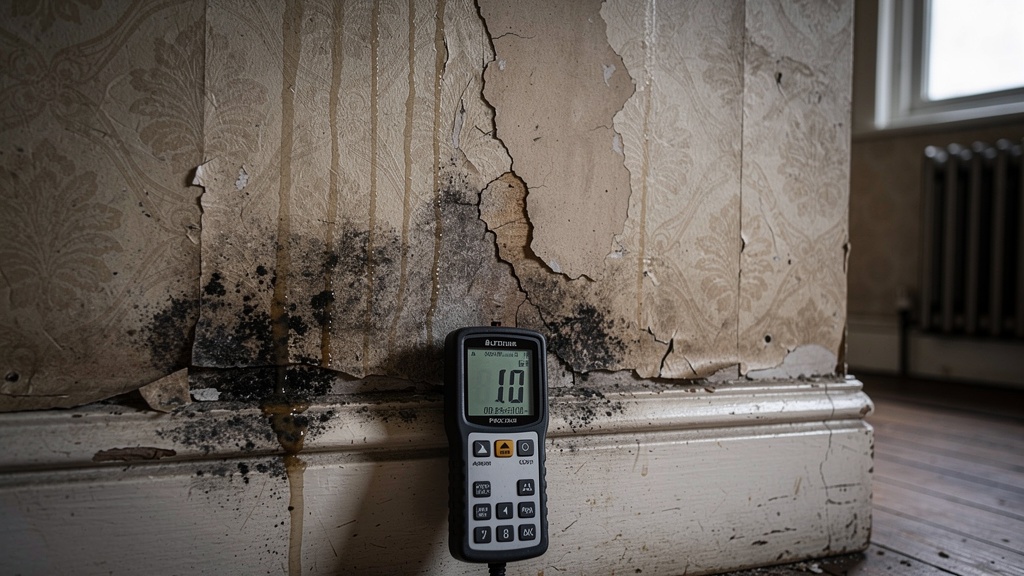
A genuine diagnosis of rising damp requires more than a visual inspection. Our surveyors use professional moisture meters to take readings at multiple heights and depths in the wall. A high reading at low level that decreases as you go higher is consistent with rising damp — but the diagnosis must rule out other causes first.
2. Penetrating Damp
Penetrating damp is caused by rainwater or moisture entering through the fabric of the building — through defective pointing, cracks in render, failed window seals, broken gutters, defective flashing or any other weakness in the external envelope. Unlike rising damp, it can appear anywhere on a wall or ceiling — wherever there's a pathway for water to enter.
In a typical Hounslow survey, penetrating damp is most commonly found:
- On chimney breasts (failed flashing or pointing)
- Around window frames (failed sealant)
- At roof level (defective flat roofs, failed leadwork)
- On external walls with eroded pointing or cracked render
- Beneath blocked gutters
Penetrating damp is generally easier to remedy than rising damp — the key is identifying and fixing the source of entry. This is why a proper diagnosis, rather than simply treating the symptoms with a waterproofing system, is so important.
3. Condensation
Condensation is by far the most common form of damp in UK homes — and the most frequently misdiagnosed as rising or penetrating damp. It occurs when warm, moist air comes into contact with a cold surface and the moisture condenses. Black mould growth on walls and around windows is the classic sign.
Condensation can be managed through improved ventilation, adequate heating and the installation of extractor fans. It's generally the least serious form of damp — but it can still cause significant damage to plasterwork, timbers and health if left unchecked.
The distinction between condensation and other forms of damp matters enormously for buyers. A vendor (or their estate agent) describing a damp problem as "just condensation" may or may not be correct. Our surveyors take moisture readings, inspect behind skirtings and check the walls internally and externally to make a proper diagnosis.
What Does a Survey Say About Damp?
In a Level 2 or Level 3 survey, your surveyor will take moisture readings throughout the property using a calibrated moisture meter. Any readings above normal ambient levels are investigated further and documented in the report. The report will describe the likely type of damp, its extent, likely cause and recommended remediation — whether that's repointing, DPC installation, improved ventilation, gutter repairs or specialist investigation.
Critically, our surveys distinguish between the types of damp. Recommending an expensive chemical DPC injection to cure what is actually condensation is unfortunately common in the remedial damp trade. Our independent assessment protects you from unnecessary expenditure.
Damp FAQ
Costs vary widely by type and extent. Simple gutter repairs might cost £200–£500. Repointing a chimney stack £500–£1,500. Chemical DPC injection £1,500–£3,000. Full waterproofing of a basement £5,000–£20,000+. Our survey reports always indicate the likely scale of remediation required to help you budget or renegotiate.
Damp does not automatically make a property unbuyable. Mild damp with a clearly identifiable and fixable cause is manageable. Serious structural damp, active mould growth or untreated penetrating damp affecting timbers is a more serious concern and should be reflected in a price reduction. We'll always give you an honest assessment of whether the damp represents a manageable issue or a significant risk.
Concerned About Damp in a Hounslow Property?
Don't rely on a vendor's word or an estate agent's reassurance. Get an independent assessment from a RICS accredited surveyor who will take actual moisture readings and give you the facts.
Book a Survey